

April 29, 2026
The Zero Hunger Game: More Pilots or Scale?
Africa is not short on ideas. It is short on scale.
With just four harvest cycles left to meet the Food and Agriculture Organization's Zero Hunger target under the United Nations Sustainable Development Goals, the continent faces a defining question:
Will we continue to pilot solutions, or will we finally move on to scale them?
According to industry estimates and data from the African Agri-Council, Africa’s agricultural financing gap stands between $65 billion and $80 billion annually. Yet, less than one-third of this need is currently met.
This is not just a funding issue; it is a systems failure. Investments are fragmented, value chains are incomplete, and commitments remain unfulfilled.
And the result? Food insecurity persists despite innovation.
Pilots Don’t Feed Nations
Across Africa, thousands of agricultural projects show promise: climate-smart farming techniques, digital agriculture platforms, and smallholder productivity programs.
At 50 hectares or 500 farmers, they work. They produce reports. They attract grants. They win awards. But they rarely reach 5,000 hectares, 50,000 farmers, or national food systems. The problem is not innovation. The problem is scalability. Scaling is not a phase; it is the mission.
In recent years, private-sector players have made bold commitments through initiatives such as the Zero Hunger Private Sector Pledge. However, there’s still a gap between announcements and action, press releases and disbursements, and intentions and infrastructure.
Whereas the actual shift now is to move from visibility to viability, from commitment to capital deployment, and from pilot projects to bankable pipelines.
Why the Value Chain Is Still Broken
Agriculture isn’t just struggling with production alone; it is failing in connection. Historically, investment has been uneven, creating gaps across the value chain.
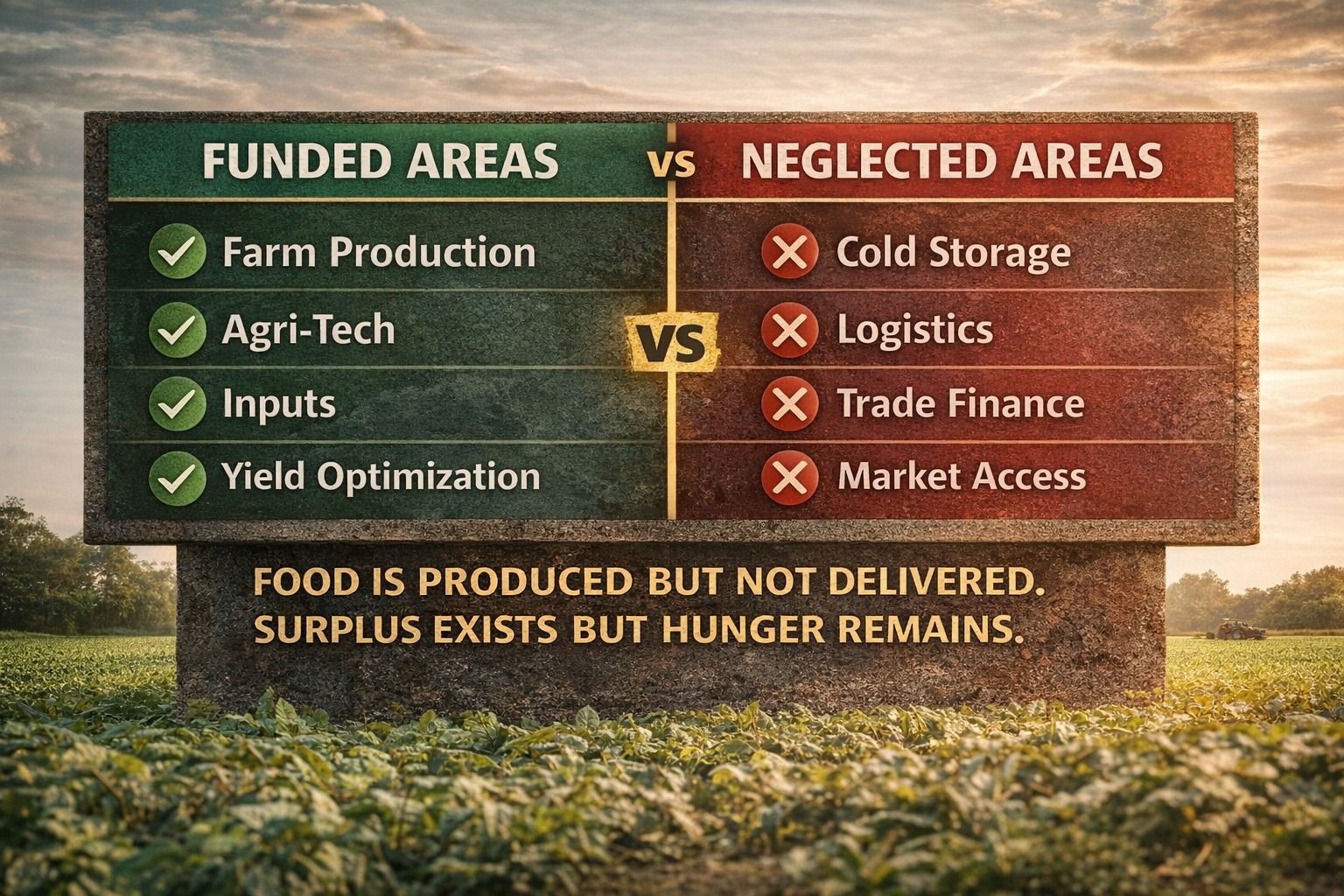
This imbalance creates a dangerous paradox: Food is produced but not delivered. Surplus exists, but hunger remains.
Scaling for Impact
Scale is often treated as the final step in agriculture. In reality, it is the entire strategy.
If Africa is to close its food security gap and meet the Zero Hunger targets set by the Food and Agriculture Organisation under the United Nations framework, then scaling must move from theory to execution across every layer of the value chain, because the truth is simple: what does not scale does not solve.
One of the biggest misconceptions in agriculture is that increasing production automatically leads to impact. It doesn’t. Without structured and reliable market access, farmers overproduce with no buyers, prices crash at harvest, and losses increase across the chain.
The shift required is from production-driven systems to market-aligned systems - connecting producers directly to buyers, structuring off-take agreements in advance, and producing based on demand signals, not assumptions. Because in agriculture, no buyer = no scale.
In addition, between microfinance and institutional capital lies a dangerous gap, the “missing middle.”
Most agribusinesses are either too large for small loans or too small and too risky for large investors. As a result, businesses that should scale simply stall.
To unlock growth at this level, financing must evolve from warehouse receipt systems to accessible working capital, from off-take agreements as collateral to reduced lending risk, and, most importantly, to increased participation from commercial banks and development finance institutions.
Agriculture also cannot scale on weak infrastructure. Even when production increases, the absence of systems leads to harvest losses, broken supply chains, and limited market reach. Scaling requires integrated infrastructure, not isolated investments. It requires agro-processing facilities close to production zones, efficient logistics and transportation networks, and cold storage to preserve value and extend shelf life.
Furthermore, scaling requires systems thinking, not silos. One of the biggest reasons agriculture struggles to scale is fragmentation. Investment flows into production, but not processing; technology, but not logistics; and inputs, but not distribution. But agriculture is a system, not a sector. Scaling demands that every link work together: farmers, processors, financiers, distributors, and retailers, because a chain does not scale at its strongest point; it breaks at its weakest link.
Notably, leadership is the hidden lever of scale. Beyond capital and infrastructure, scaling is ultimately a leadership challenge. Agribusiness leaders across Africa face real constraints, currency volatility affecting profitability, complex cross-border trade systems, talent shortages in technical and operational roles, and inefficient supply chains. Scaling requires leaders who can think regionally, not locally; build resilient systems, not short-term wins; and navigate complexity with clarity.
Finally, Africa does not need more successful pilots. It needs repeatable, investable, scalable systems. That is to say, the Zero Hunger goal is not out of reach, but it is out of time for experimentation without expansion. Only then can agriculture move from potential to performance, and only then can Zero Hunger become more than a goal but a reality within reach.
With four harvests left, the question is no longer what works. It is if we will scale what works best fast enough.
References
- Food and Agriculture Organisation (FAO) - Global hunger and food systems data
- African Agri Council (AAC) - African Agri Investment Indaba Press Release, 2026
- United Nations - Sustainable Development Goal 2: Zero Hunger


Related Content

Oct 01 2023
Agritech as an essential partner for enhancing food security in Nigeria
Oct 18 2023